I've been spending a lot of time lately giving our main review website a face-lift to make it look a bit more professional, as I was always bothered by it's very poor looks...
In the process I've added some new features, such as a search across all our websites, which I think is really useful as it can be very hard to find things sometimes....
A few more updates and new features will continue for the next few weeks, hopefully without too many hick-ups. I've also rewritten quite a few of the guides, fixed up broken links, improved loading speed by reducing files sizes, etc... I'd love to hear any feedback on what people think of it, while I'm still working on the changes and not gone too far with the major changes.
I've also been adding a lot more reviews of other brands, like the very recent Butterfly Tenergy review, Donic JO Coppa Platin Review and Hallmark Phoenix Review. A lot more features and reviews are in the pipeline!
I've still got a few sections to complete, but most of the rest of the site is getting closer to being finished, apart from the reviews which I'll just continue to add! My aim is to make it the most comprehensive table tennis resource on the internet!
Monday, May 26, 2008


Thursday, May 08, 2008
Donic rubber and blade combinations
I have recently spend a fair bit of time building the Donic Online Australia website, which I provide a lot more details about donic products, such as comments, reviews and hi-res pictures.
I've also added a section called Donic Solutions, where I've spent many hours trying to figure out the best Donic blades and rubbers combinations for specific styles.
I've tried to explain the reasons of my combination choices in the descriptions, so that players understand why certain combinations work well together, which can help them make decision for other rubber and blade combinations as well.
I've got a bit more work to do on the site, but it's starting to look quite nice now, and I'm sure it will be useful to some players as well...
Any comments on the site or blade and rubber combinations would be very much appreciated!
I've also added a section called Donic Solutions, where I've spent many hours trying to figure out the best Donic blades and rubbers combinations for specific styles.
I've tried to explain the reasons of my combination choices in the descriptions, so that players understand why certain combinations work well together, which can help them make decision for other rubber and blade combinations as well.
I've got a bit more work to do on the site, but it's starting to look quite nice now, and I'm sure it will be useful to some players as well...
Any comments on the site or blade and rubber combinations would be very much appreciated!
Wednesday, May 07, 2008
Donic JO Coppa Platin and Platin Soft - NEW!
Donic has just released 2 new rubbers in their tensor range, the Donic JO Coppa Platin and the Donic JO Coppa Platin Soft.
I have been very impressed with their latest ones, the JO Coppa Gold, the Desto F3 Big Slam and particularly the JO Coppa Silver, bring the best glue effect I've felt to date. These new ones promises even better glue effect an more speed.... Truth or marketing at it's best? Time will tell...
I've got got both these new rubbers on order, and will test them in a few weeks time, and will publish my review here....
I have been very impressed with their latest ones, the JO Coppa Gold, the Desto F3 Big Slam and particularly the JO Coppa Silver, bring the best glue effect I've felt to date. These new ones promises even better glue effect an more speed.... Truth or marketing at it's best? Time will tell...
I've got got both these new rubbers on order, and will test them in a few weeks time, and will publish my review here....
Tuesday, April 29, 2008
Donic Desto F3 Big Slam
I had a go with this rubber on a Dawei Navigator blade the other day, wow the glue effect built into this rubber is huge!
The sponge is really soft (around 30degrees I reckon) and the topsheet thin, sensitive and very grippy. It's amazing how little effort it takes to open up with a loop with this rubber, and it's so easy to generate huge spin! I've never come across a rubber where you can generate a medium pace and very spinny loop with such little effort!
I reminds me very much of the Joola Tango, but the glue effect and sound is a LOT higher.
I think it suits a backhand more than a forehand, as it's great for an opening loop or a flick, followed by a powerful forehand. The rubber is not real fast on loops, although it hits really well, coming off fast with a very loud click.
So it suits a more control and spin based game, but combined with a faster and firmer sponged forehand, it can suit a very offensive style game. With a thinner sponge (1.8mm is the thinnest) it would work very well for a chopper, whereas with 2.0 or MAX a more offensive and very spinny game would be appropriate.
Another review and some more details can be found on the Donic Online Australia website
The sponge is really soft (around 30degrees I reckon) and the topsheet thin, sensitive and very grippy. It's amazing how little effort it takes to open up with a loop with this rubber, and it's so easy to generate huge spin! I've never come across a rubber where you can generate a medium pace and very spinny loop with such little effort!
I reminds me very much of the Joola Tango, but the glue effect and sound is a LOT higher.
I think it suits a backhand more than a forehand, as it's great for an opening loop or a flick, followed by a powerful forehand. The rubber is not real fast on loops, although it hits really well, coming off fast with a very loud click.
So it suits a more control and spin based game, but combined with a faster and firmer sponged forehand, it can suit a very offensive style game. With a thinner sponge (1.8mm is the thinnest) it would work very well for a chopper, whereas with 2.0 or MAX a more offensive and very spinny game would be appropriate.
Another review and some more details can be found on the Donic Online Australia website
Wednesday, March 26, 2008
JUIC Leggy vs TSP P-1R
I've finally decided to change over to JUIC Leggy 1.0mm from the TSP P-1r 1.2mm. Although they are similar in many ways and both excellent pips, it's one unique property of the leggy that suits my game particularly well that's helped me decide. The main differences are:
1. The main reason I've changed to Leggy is the remarkable amount of backspin I can generate from a backspin ball. if someone pushes to the LP, you can push back hard with a little flick of the wrist (which I used to be real good at with inverted) and get quite good backspin and it's easy to keep it low.. and if you keep it deep it often forces another push which you can attack, or a weaker loop which you can either attack, or get into you chopping mode. If I push the backspin ball back lightly, it reverses the spin very much like most LPs, so that option is still there.
2. Chopping away from the table both LPs play similar, with the Leggy offering a bit more reversal, but the P-1r more options to manipulate the spin as it seems to have more grip. Control is similar.
The TSP is also more durable, as they just seem to go on forever, whereas I've already lost a pip on my leggy... but this is still secondary to me and performance has to be No 1. I've been using the Leggy for about a month, and I do a lot of blocking against fast loops/hits and DO hit with it myself as well. I find it no less durable than any other pips I've tried, except the TSPs.
1. The main reason I've changed to Leggy is the remarkable amount of backspin I can generate from a backspin ball. if someone pushes to the LP, you can push back hard with a little flick of the wrist (which I used to be real good at with inverted) and get quite good backspin and it's easy to keep it low.. and if you keep it deep it often forces another push which you can attack, or a weaker loop which you can either attack, or get into you chopping mode. If I push the backspin ball back lightly, it reverses the spin very much like most LPs, so that option is still there.
2. Chopping away from the table both LPs play similar, with the Leggy offering a bit more reversal, but the P-1r more options to manipulate the spin as it seems to have more grip. Control is similar.
The TSP is also more durable, as they just seem to go on forever, whereas I've already lost a pip on my leggy... but this is still secondary to me and performance has to be No 1. I've been using the Leggy for about a month, and I do a lot of blocking against fast loops/hits and DO hit with it myself as well. I find it no less durable than any other pips I've tried, except the TSPs.
Friday, January 18, 2008
Changing to thicker sponge long pimple rubber
After having played with TSP P-1r 0.6mm for at least a year, I thought I might give a thicker (1.2mm) sponge a go. One thing I'm hoping for is to be able to generate more backspin on retrun of serves, as this can mean the difference between yuor opponent powerlooping one past you, or a slower spinny loop which is what you want...
I only had one session so far, of more of a social hit, but here some of my impressions:
1. Returning serves: I don't think the control has changed a lot, perhaps a little less, but I did feel I could put more spin on the ball. My returns against deeper and faster balls seemed to generate more floaters, which my opponents had more trouble with than with 0.6mm. Although this is a bonus, i need to work more on variation with this, so that I feel in control of what I'm doing...
2. Chopping: It's a little more sensitive to incoming spin, so as this rubber is already quite sensitive compared to others, it's something to be weary off. A softer touch is the answer. The positive was that I seemed to be ably to keep the ball shorter more easily, with more spin... I consider the 1.2mm quite an improvement, and it's an exceptional for chopping from mid- long distance... Control wise I think it's a little less with 1.2mm...
3. Short game: It's more lively but also feels softer with more grip... I didn't feel I had any less control, and attacking some short balls with a quick flick was a lot easier. passive shots: You simply cannot affort to simply put your bat there and hope for it to go over with this rubber. Since it's uite sensitive to incoming spin, it will grip, and can easily product high nospin balls, whhc good players will put away.
4. Attacking: A great improvement in this area! Attacking backspin became easier, which surprised me a little...the softer feel of the ruber (coz of the thicker sponge) just seemed to give me more feel and control. Counter hitting against topspin is still not that easier, but can produce deadly balls when you get the timing right...and fast too!
5. Generating spin: I could certainly generate more spin with this rubber, and had my opponent put a few into the net off a serve with it, since they still expect no-spin from a LP rubber. This abilty also shines when chopping, as you can really change and manipulate the spin easily, and produce very dangerou an awkward balls.
6. Conclusion: This rubber is not the easiest to control, mainly due to it's sensitivity to spin. , but this same property gives you control over spin, and allows you to manipulate it better. With the right strokes this rubber offers great control, and is one of hte most dangeorus long pimples out there. Going from 0.6mm to 1.2mm just enhances these properties... incorrent or passive strokes will be punished, correct strokes rewarded... I think the thicker sponge enhanced both the short game AND the away from the table chopping game, but you must use active strokes, can't just stick you bat there...
I only had one session so far, of more of a social hit, but here some of my impressions:
1. Returning serves: I don't think the control has changed a lot, perhaps a little less, but I did feel I could put more spin on the ball. My returns against deeper and faster balls seemed to generate more floaters, which my opponents had more trouble with than with 0.6mm. Although this is a bonus, i need to work more on variation with this, so that I feel in control of what I'm doing...
2. Chopping: It's a little more sensitive to incoming spin, so as this rubber is already quite sensitive compared to others, it's something to be weary off. A softer touch is the answer. The positive was that I seemed to be ably to keep the ball shorter more easily, with more spin... I consider the 1.2mm quite an improvement, and it's an exceptional for chopping from mid- long distance... Control wise I think it's a little less with 1.2mm...
3. Short game: It's more lively but also feels softer with more grip... I didn't feel I had any less control, and attacking some short balls with a quick flick was a lot easier. passive shots: You simply cannot affort to simply put your bat there and hope for it to go over with this rubber. Since it's uite sensitive to incoming spin, it will grip, and can easily product high nospin balls, whhc good players will put away.
4. Attacking: A great improvement in this area! Attacking backspin became easier, which surprised me a little...the softer feel of the ruber (coz of the thicker sponge) just seemed to give me more feel and control. Counter hitting against topspin is still not that easier, but can produce deadly balls when you get the timing right...and fast too!
5. Generating spin: I could certainly generate more spin with this rubber, and had my opponent put a few into the net off a serve with it, since they still expect no-spin from a LP rubber. This abilty also shines when chopping, as you can really change and manipulate the spin easily, and produce very dangerou an awkward balls.
6. Conclusion: This rubber is not the easiest to control, mainly due to it's sensitivity to spin. , but this same property gives you control over spin, and allows you to manipulate it better. With the right strokes this rubber offers great control, and is one of hte most dangeorus long pimples out there. Going from 0.6mm to 1.2mm just enhances these properties... incorrent or passive strokes will be punished, correct strokes rewarded... I think the thicker sponge enhanced both the short game AND the away from the table chopping game, but you must use active strokes, can't just stick you bat there...
Friday, December 28, 2007
JUIC Australia website
JUIC is a Japanese company that manufacturers professional table tennis equipment. Having tried a range of their products, I find them of very high quality, and certainly as good as any of the other top Japanese table tennis equipment manufacturers, and they've shown some great innovation for some of their products too!
Because there is so little information on their products, I've put together a little website here:
Because there is so little information on their products, I've put together a little website here:
JUIC Australia online
I've included a range of JUIC blades and JUIC rubber descriptions and reviews, and also further information on some of their unique products, like the Ecolo Expander II.
I thought it would be useful to provide some suggestions on JUIC blade and rubber combinations as well, since it can be hard to choose something suitable out of such a wide range.
JUIC has also just released a range of their Tune-up rubbers, which will be reviewed on this site shortly.
Any feedback on this site, and how I can further improve it would be very much appreciated!
I thought it would be useful to provide some suggestions on JUIC blade and rubber combinations as well, since it can be hard to choose something suitable out of such a wide range.
JUIC has also just released a range of their Tune-up rubbers, which will be reviewed on this site shortly.
Any feedback on this site, and how I can further improve it would be very much appreciated!
Monday, December 03, 2007
Spinmax reviews, tests and FAQs
I'm becoming quite a fan of Spinmax, and use it regularly now. I've done quite a few test and experiments, to determine how well it work, and what the differences are between the original Spinmax Red and the new Spinmax Aqueous.
Instead of writing another article on it, which will probably just get lost and forgotten, I've set up a little website on a subdomain, with descriptions of the products, instructions on how to use it, and a FAQ section for new users or those that may want to try it;

I will continue to do more Spinmax reviews and tests and try it on different rubbers, and will add any further questions to the Spinmax FAQ section. Feel free to ask questions here or within a section of the table tennis forum so that questions (and answers) can be added to the FAQ section.
Friday, November 23, 2007
Is JUIC Ecolo Expander II still worthwhile?
With the introduction of a variety of VOC free speed glue alternatives, some have said that the JUIC Ecolo Expander II (EEII) is no longer a viable option for those looking a little more performance out of their rubber.
I don’t agree and I do think the EEII has it's place, but it can't compete in terms of speed glue effect. It really depends on what you’re looking for and what you expectation are… and the trouble is… most people don’t know…
For those that currently speed glue their rubbers with a few layers, and looking for a VOC free alternative, I would not recommend the EEII, as the effect is simply not strong enough. These people would be better off looking at other VOC free alternatives, like the VOC free glue Falco Tempo Unlimited or sponge treatment liquids like Falco Tempo Booster or Tibhar Clean Tuning, as the effect of these really is very close to several layers of speed glue.
However for those that perhaps use a light layer of speed glue, or have not glued before and are looking for a little extra performance of their rubber, the EEII is a very good option. It stretches the rubber quite a bit, and softens the sponge by a few degrees, and it does have the feel of a lightly glued rubber. Also don’t forget that the effect of EEII is pretty much permanent for the life of the rubber, so you treat it once, and the effect remains for a few months! Not only that, but since the liquid is very thin and spread out so easily, only very little is used per application, so a single bottle may well last you for many years!
I think part of the problem is also that people do not know how to use the EEII properly or do not fully utilize it’s potential. The instructions provided by the manufacturer are quite brief, and there are quite a few variables that that affect the performance. Not only that, but the liquid is very thin, and if you’re not careful it can leak to the topsheet which does not do it any good. However when used properly with a few simple precautions, it’s quite easy to apply, and can be very effective.
Another property of the EEII that is often overlooked is how it can soften and loosen up a sheet, that may otherwise be quite stiff and takes time to wear in. This is most common among a range of Chinese style rubber. A simple EEII treatment will immediately make the sheet more responsive / dynamic. Yet another useful property is that it makes the sheet more reactive to glue… although I don’t know if this applies to VOC free glues. So as a pre-treatment for a rubber you’re going to speed glue, it is not bad option.
So in my opinion the EEII is still a very good product, but simply not for everyone. The cost is low compared to any other type of rubber enhancing products, and a single little bottle is likely to last you for years.
I don’t agree and I do think the EEII has it's place, but it can't compete in terms of speed glue effect. It really depends on what you’re looking for and what you expectation are… and the trouble is… most people don’t know…
For those that currently speed glue their rubbers with a few layers, and looking for a VOC free alternative, I would not recommend the EEII, as the effect is simply not strong enough. These people would be better off looking at other VOC free alternatives, like the VOC free glue Falco Tempo Unlimited or sponge treatment liquids like Falco Tempo Booster or Tibhar Clean Tuning, as the effect of these really is very close to several layers of speed glue.
However for those that perhaps use a light layer of speed glue, or have not glued before and are looking for a little extra performance of their rubber, the EEII is a very good option. It stretches the rubber quite a bit, and softens the sponge by a few degrees, and it does have the feel of a lightly glued rubber. Also don’t forget that the effect of EEII is pretty much permanent for the life of the rubber, so you treat it once, and the effect remains for a few months! Not only that, but since the liquid is very thin and spread out so easily, only very little is used per application, so a single bottle may well last you for many years!
I think part of the problem is also that people do not know how to use the EEII properly or do not fully utilize it’s potential. The instructions provided by the manufacturer are quite brief, and there are quite a few variables that that affect the performance. Not only that, but the liquid is very thin, and if you’re not careful it can leak to the topsheet which does not do it any good. However when used properly with a few simple precautions, it’s quite easy to apply, and can be very effective.
Another property of the EEII that is often overlooked is how it can soften and loosen up a sheet, that may otherwise be quite stiff and takes time to wear in. This is most common among a range of Chinese style rubber. A simple EEII treatment will immediately make the sheet more responsive / dynamic. Yet another useful property is that it makes the sheet more reactive to glue… although I don’t know if this applies to VOC free glues. So as a pre-treatment for a rubber you’re going to speed glue, it is not bad option.
So in my opinion the EEII is still a very good product, but simply not for everyone. The cost is low compared to any other type of rubber enhancing products, and a single little bottle is likely to last you for years.
Thursday, November 22, 2007
Update on Falco Booster on Globe 999 National rubber
I wrote earlier about using the Falco Booster on my Globe 999 National rubber, and how I was very impressed with it. Well I've used it for over 2 weeks now, and the effect is still great! I feel it's really helping my game having a glued up rubber that feels the same all the time...
I suspect it will last till the end of 3 weeks, after which I'll remove it and re-apply 1-2 layers of booster to see if I can get the same effect. Less booster is supposed to be required to get the same effect, so hopefully I get right or close to it, so that I can get a consistant effect for life of the rubber....
I will update again after the next application of the booster...
I suspect it will last till the end of 3 weeks, after which I'll remove it and re-apply 1-2 layers of booster to see if I can get the same effect. Less booster is supposed to be required to get the same effect, so hopefully I get right or close to it, so that I can get a consistant effect for life of the rubber....
I will update again after the next application of the booster...
Monday, November 12, 2007
Review JUIC Neo Anti
I tried this rubber last weekend since a friend kindly lend me his bat to try (cheers mate!)
This rubber has a very slippery feel on the surface, but the topsheet is thin and the sponge is very soft. JUIC description of the rubber is given below, and I find this quite accurate:
'Juic Neo Anti kills the spin of your opponent's ball, and with its dead, slow speed gives incredible control. But the elastic surface combined with special sponge gives the added element of tricky spin when the ball is hit hard.'
For chopping the control of this rubber is excellenet, similar to long pips, but it does not allow as much variation as some of the grippier long pips out there. Still I felt I could generate some spin, and it had decent spin reversal.
Close-in it blocks remarkable well against fast loops... it seem to take the pace out of even the hardest loops, and return it real slow, mid-table with no spin. The soft and slow sponge is no doubt the key here...wish they used this sponge on some long pimple rubbers.
Similaryl against slow loops, attacking them with a quick closed-bat action (as I do with long pips) worked very effectively.
Against slower spinny shots or serves, if you make light contact the spin reveral is big and it's very insensitve to incoming spin. Hit a little harder and it grips a bit, and it seems to take a lot of the spin off.
Against no-spin it's very easy to control and keep low. I could attack quite well with, but hitting it to hard does not work, since the real soft sponge just bottoms out, and you're hitting with the wood. You can certainly lift the ball with it if you dig the ball in a little, and attack with a slow mild topspin...
This rubber is far more versatile than the antispin rubbers I've tried before, and gives you a lot more options that just getting the ball back... Although it's not a long pimple rubber, it's properties are a lot like it, much closer than they are to inverted. The real slow sponge is something I look for in long pimple rubbers, but does not seem the common.
This rubber would have to be a real contender for those that are used to slow frictionless rubbers, and are finding it hard to adjust to the much faster and springier grippy long pimples...
For more details see here writeup here: Review JUIC Neo Anti
This rubber has a very slippery feel on the surface, but the topsheet is thin and the sponge is very soft. JUIC description of the rubber is given below, and I find this quite accurate:
'Juic Neo Anti kills the spin of your opponent's ball, and with its dead, slow speed gives incredible control. But the elastic surface combined with special sponge gives the added element of tricky spin when the ball is hit hard.'
For chopping the control of this rubber is excellenet, similar to long pips, but it does not allow as much variation as some of the grippier long pips out there. Still I felt I could generate some spin, and it had decent spin reversal.
Close-in it blocks remarkable well against fast loops... it seem to take the pace out of even the hardest loops, and return it real slow, mid-table with no spin. The soft and slow sponge is no doubt the key here...wish they used this sponge on some long pimple rubbers.
Similaryl against slow loops, attacking them with a quick closed-bat action (as I do with long pips) worked very effectively.
Against slower spinny shots or serves, if you make light contact the spin reveral is big and it's very insensitve to incoming spin. Hit a little harder and it grips a bit, and it seems to take a lot of the spin off.
Against no-spin it's very easy to control and keep low. I could attack quite well with, but hitting it to hard does not work, since the real soft sponge just bottoms out, and you're hitting with the wood. You can certainly lift the ball with it if you dig the ball in a little, and attack with a slow mild topspin...
This rubber is far more versatile than the antispin rubbers I've tried before, and gives you a lot more options that just getting the ball back... Although it's not a long pimple rubber, it's properties are a lot like it, much closer than they are to inverted. The real slow sponge is something I look for in long pimple rubbers, but does not seem the common.
This rubber would have to be a real contender for those that are used to slow frictionless rubbers, and are finding it hard to adjust to the much faster and springier grippy long pimples...
For more details see here writeup here: Review JUIC Neo Anti
Falco Booster on Chinese hard sponged rubbers
My usual Globe 999 Nat (black) was showing signs of wear, so it was time for a new sheet, and I decided I'd give the Falco booster a go on this, and see if it would be a good enough substitude to my Tibhar Rapid Clean Deluxe speed glue, which I won't be able to us as of middle of next year...
I put 3 layers of booster on it over 2 days. The dome was big, basically touching on the ends. After 24h (after the last layer) it still had a decent dome but was coming down, so I glued it down with the Falco Water glue. The dome was still quite strong especially with this firmer sponged rubbers, so it still lifted slightly on the tip but did not lift further... I'll wait a little longer next time...and will take more care putting enough glue on the tip of the blade...
Well the booster softened the sponge heaps, and stretched it at least 5mm in both directions. I was VERY happy with the performance, it felt as good as with the Tibhar RCD. The sponge had softened at least as much with the booster as with the RCD, probably a little more considering it was the 1st gluing. With the RCD it usually softens more after a few gluings, so it will be interesting to see if the booster softens it more as well. Speed and spin wise it felt just as good. I will now see how long it lasts... but I have finally found a good substitude for my Tibhar Rapid Clean Deluxe...
I wrote a detailed review on the Booster here:
Falco Tempo Booster review
I put 3 layers of booster on it over 2 days. The dome was big, basically touching on the ends. After 24h (after the last layer) it still had a decent dome but was coming down, so I glued it down with the Falco Water glue. The dome was still quite strong especially with this firmer sponged rubbers, so it still lifted slightly on the tip but did not lift further... I'll wait a little longer next time...and will take more care putting enough glue on the tip of the blade...
Well the booster softened the sponge heaps, and stretched it at least 5mm in both directions. I was VERY happy with the performance, it felt as good as with the Tibhar RCD. The sponge had softened at least as much with the booster as with the RCD, probably a little more considering it was the 1st gluing. With the RCD it usually softens more after a few gluings, so it will be interesting to see if the booster softens it more as well. Speed and spin wise it felt just as good. I will now see how long it lasts... but I have finally found a good substitude for my Tibhar Rapid Clean Deluxe...
I wrote a detailed review on the Booster here:
Falco Tempo Booster review
Thursday, October 18, 2007
New pimples website - PIPS
With a group of friends we've started a new website dedicated to pimple rubbers and players:
"Pips is a table tennis equipment site set up by a group of like-minded table tennis players that are keen to educate the table tennis community about long pimpled and other pimpled rubbers. We feel these rubbers add great diversity to our game, and it's something that should be embraced, and not frowned upon or dimissed as a 'cheater's rubber'. "
There are already some excellent articles on the website, and more in the pipeline. We will also continue to add more reviews on new and old pimples rubbers. The latest news will also be added shortly.
Please have a look at the site and read through the articles, and any feedback would be very much appreciated! Please be brutally honest, we won't take offense!
If any of you would like to contribute, that would be awesome! We're not just after people with highly technical knowledge or high level players...Contributions like any of the following would be just as great:
It would also help if some of you can promote the site a little... This can bring more people to the site and hopefully will bring more contributors... which is better for everyone! I'd really like this to be a website that is an authority on pimples rubbers, and something that all us pip players can feel part off! Thanks to everyone who's already contributed so far!
Cheers!
"Pips is a table tennis equipment site set up by a group of like-minded table tennis players that are keen to educate the table tennis community about long pimpled and other pimpled rubbers. We feel these rubbers add great diversity to our game, and it's something that should be embraced, and not frowned upon or dimissed as a 'cheater's rubber'. "
There are already some excellent articles on the website, and more in the pipeline. We will also continue to add more reviews on new and old pimples rubbers. The latest news will also be added shortly.
Please have a look at the site and read through the articles, and any feedback would be very much appreciated! Please be brutally honest, we won't take offense!
If any of you would like to contribute, that would be awesome! We're not just after people with highly technical knowledge or high level players...Contributions like any of the following would be just as great:
- Funny pimple stories
- Simply pimple strategies that work for you (just a paragraph can be enough)
- Some pimple history - Finding any graphics / pics for the site
- Anyone with a little website design experience that can make the site look a little better than our current very basic effort.
It would also help if some of you can promote the site a little... This can bring more people to the site and hopefully will bring more contributors... which is better for everyone! I'd really like this to be a website that is an authority on pimples rubbers, and something that all us pip players can feel part off! Thanks to everyone who's already contributed so far!
Cheers!
Friday, September 28, 2007
Review of AVALOX AXV MO 0.5mm long pimples
AVALOX AXV MO 0.5mm

First impressions:
The rubber looks of pretty good quality. The only words on there are AXV, MO and 'made in China'... I'm not sure what the story is between the names Avalox and AVX, but that does nto matter for this review.
The colour of the rubber seems a little orange... I've seen a few rubbers like this, so it does not appear to be an issue.
Pimple size looks close to maximum length... perhaps a touch shorter, but does not look a lot different to 955 or TSP P-1R. Tips are rough and feel quite grippy. the pimple are a little stiff, probably a grade stiffer than the 955 and a fair bit stiffer than the P-1R.
They are spaced out more than both the 955 and TSP though...
I've only had a bried hit with it so far, and found it to be quite nice alround but a little faster than both the 955 and TSP. From the bried hit i had I immediately noticed it's quite good for hitting and blocking, but I'd need to adjust to the speed for chopping...
I'll get onto spin reversal and disturbing effect when I've had another hit with it...a good hit against a looper is what i need...
Part 2:
This rubber plays quite nice alround... and does not feel too different to the Galaxy 955.
For chopping it's faster and offer a little less feel and control, but still very good.
Spin reversal is fairly good too... the stiffer pimples seem to help here. It does offer good control against fast loops as well, which I only found in the 955 before. It is particularly good for hitting though... attacking backspin and hitting through spin seemed particularly easy.
It blocks well, but because it feels a little springy, drop shots are not as easy... It seems not all that sensitive to incoming spin, again the stiffer pips seem to help here...
In summary it's a good all round long pimple rubber, suitable for both chopping and attacking. It's best feature is the control offerred on hits, and it's relatively insensitivity to incoming spin.
I'm planning to have another go with this rubbers... haven't quite figured it all out yet...
Sunday, September 09, 2007
Spinmax Aqueous - new VOC free spinmax
Spinmax have come up with a new and water based version of their popular Spinmax cleaner, called Spinmax Aqueous.
This appear to be the same as the Joola Spinmax Green Power, as when you check the Material safesheet data sheet for the Joola spinmax green power, it shows the Spinmax Aqueous.
Although spinmax is technically classed as a rubber cleaner, it's more than this... it tends to enhance the friction coefficient of the rubber surface, making it tackier / stickier. For chinese style tacky rubbers this is great as it leaves them stickier for longer. Although many use it for non-tacky rubbers as well, you should remember that it will make these rubbers tacky as well, which is not what they were designed to be like.
There are some details on this new product here: Spinmax Aqueous but I will do a full review shortly, when I've had a chance to test it.... I hear it's already quite popular in Japan and Germany, so I can't see why this new one should not be popular either...
The fact that it's water based, and contains no volatile compound, and is not flammable, should make it popular, as it won't be affected by the up and coming speed glue ban, and it can be shipped safely and cheaper via air....
This appear to be the same as the Joola Spinmax Green Power, as when you check the Material safesheet data sheet for the Joola spinmax green power, it shows the Spinmax Aqueous.
Although spinmax is technically classed as a rubber cleaner, it's more than this... it tends to enhance the friction coefficient of the rubber surface, making it tackier / stickier. For chinese style tacky rubbers this is great as it leaves them stickier for longer. Although many use it for non-tacky rubbers as well, you should remember that it will make these rubbers tacky as well, which is not what they were designed to be like.
There are some details on this new product here: Spinmax Aqueous but I will do a full review shortly, when I've had a chance to test it.... I hear it's already quite popular in Japan and Germany, so I can't see why this new one should not be popular either...
The fact that it's water based, and contains no volatile compound, and is not flammable, should make it popular, as it won't be affected by the up and coming speed glue ban, and it can be shipped safely and cheaper via air....
Sunday, August 26, 2007
Update on the experiment with different cleaners
Well I proceeded to give the old rubber a real, good coating of the same olive oil. It take about 15min before it started to soak on several places on the surface.
As recommended by those mentioned before, the oil should be spread out again to prevent some minor markings on the surface. The next day I checked the rubber and there were no marks, and all the oil had been soaked up.
Testing the rubber the next day showed the rejuvination processes worked really well. Although it did not feel as good as a new rubber, it felt better than a rubber with just a good clean...
I would not recommend you use this procedure on a regular basis, as I suspect it may soften the topsheet more and more, and will make the rubber heavier as well. But for a occasional good clean it seemed to work really well! Plus it's cheap and every tends to have this in their kitchen... according to others most vegetable oils work well, so I don't think it needs to olive oil.
As recommended by those mentioned before, the oil should be spread out again to prevent some minor markings on the surface. The next day I checked the rubber and there were no marks, and all the oil had been soaked up.
Testing the rubber the next day showed the rejuvination processes worked really well. Although it did not feel as good as a new rubber, it felt better than a rubber with just a good clean...
I would not recommend you use this procedure on a regular basis, as I suspect it may soften the topsheet more and more, and will make the rubber heavier as well. But for a occasional good clean it seemed to work really well! Plus it's cheap and every tends to have this in their kitchen... according to others most vegetable oils work well, so I don't think it needs to olive oil.
Sunday, August 19, 2007
Experimenting with different cleaners
I've heard many stories of players and friends using all sort of liquids to clean or rejuvinate their rubbers. I decided to put some of these to the test.
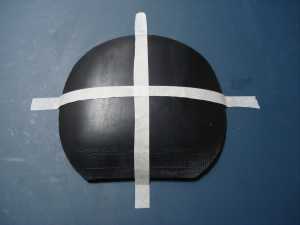
I found an old rubber (Dawei Sprungfeder A-4) which has had a lot of use and is well worn. It's now totally non-tacky and has even lost a lot of it's grip... feels quite smooth.
As you can see below I have divided up the rubber into 4 sections with masking tape, each section can be treated with a different cleaner so that we can compare the results. I know water will not revive this rubber, so I won't use this as a test.
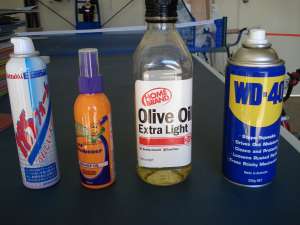
Here are the 4 cleaners I decided to use:
I used a seperate cotton cloth to wipe the liquids in. In hindside something less absorbing and lint-free would have been better, but I don't think it will affect the results.
Thanks goes to hookshot, pongcrazy, LawOCG and a few other (see forum thread, sorry if I missed you) for all the excellent suggestions and advice.
The results are not as conclusive as I had hoped... all seem to work quite well:
Nittuku rubber cleaning foam:
The foam makes it real easy to apply and does not spill easy so less chance of a mess. It gave a good clean, restoring some of it's grippiness but no real tack. It changed the look of the rubber very little.
Orange power:
Since it's a spray it's a little messy, but it smells so good I was tempted to just keep using it Very Happy Laughing Very Happy . It does soak into the cloth and/or evaporate real quick, so I had to spray a few more times so that I could really rub the complete surface before it dried. As with the foam, it gave a good clean, restoring some of it's grippiness but no real tack. It changed the look of the rubber very little. It let some orange stains on the cloth.
WD40:
Since it's a spray it's a little messy. It smells a little toxic, so it may well have some nasties in it. It does soak into the cloth and/or evaporate real quick, so I had to spray a few more times so that I could really rub the complete surface before it dried. As with the foam, it gave a good clean, restoring some of it's grippiness but no real tack. It changed the look of the rubber very little.
Olive oil:
Since I had to pour some drop onto the rubber, it got a little messy too. I spread it around covering it with a very light layer. It seem to absorb quite quite quickyl As it was dry in about half the surface, I wiped it around a little more with the cloth which was still oily to cover it some more. It soaked in after about 10mins. This was seemed slighly better, and actually made the surface look a little better too. It will need some applications to see what more it can do.
So from this I conclude that for easy of use, I recommend the foam as it gives a good clean as any, and is the least messy. The oil gives the best result, and further and more oil may will offer better results again, but it's obviously not as good for a quick clean. For most enjoyable experience, the orange power wins hands down, since it smells so delicious! heh heh...
I will treat the whole rubber with a thicker layer of oil again, to see how much more I can do with it...
I found an old rubber (Dawei Sprungfeder A-4) which has had a lot of use and is well worn. It's now totally non-tacky and has even lost a lot of it's grip... feels quite smooth.
As you can see below I have divided up the rubber into 4 sections with masking tape, each section can be treated with a different cleaner so that we can compare the results. I know water will not revive this rubber, so I won't use this as a test.
Here are the 4 cleaners I decided to use:
I used a seperate cotton cloth to wipe the liquids in. In hindside something less absorbing and lint-free would have been better, but I don't think it will affect the results.
Thanks goes to hookshot, pongcrazy, LawOCG and a few other (see forum thread, sorry if I missed you) for all the excellent suggestions and advice.
The results are not as conclusive as I had hoped... all seem to work quite well:
Nittuku rubber cleaning foam:
The foam makes it real easy to apply and does not spill easy so less chance of a mess. It gave a good clean, restoring some of it's grippiness but no real tack. It changed the look of the rubber very little.
Orange power:
Since it's a spray it's a little messy, but it smells so good I was tempted to just keep using it Very Happy Laughing Very Happy . It does soak into the cloth and/or evaporate real quick, so I had to spray a few more times so that I could really rub the complete surface before it dried. As with the foam, it gave a good clean, restoring some of it's grippiness but no real tack. It changed the look of the rubber very little. It let some orange stains on the cloth.
WD40:
Since it's a spray it's a little messy. It smells a little toxic, so it may well have some nasties in it. It does soak into the cloth and/or evaporate real quick, so I had to spray a few more times so that I could really rub the complete surface before it dried. As with the foam, it gave a good clean, restoring some of it's grippiness but no real tack. It changed the look of the rubber very little.
Olive oil:
Since I had to pour some drop onto the rubber, it got a little messy too. I spread it around covering it with a very light layer. It seem to absorb quite quite quickyl As it was dry in about half the surface, I wiped it around a little more with the cloth which was still oily to cover it some more. It soaked in after about 10mins. This was seemed slighly better, and actually made the surface look a little better too. It will need some applications to see what more it can do.
So from this I conclude that for easy of use, I recommend the foam as it gives a good clean as any, and is the least messy. The oil gives the best result, and further and more oil may will offer better results again, but it's obviously not as good for a quick clean. For most enjoyable experience, the orange power wins hands down, since it smells so delicious! heh heh...
I will treat the whole rubber with a thicker layer of oil again, to see how much more I can do with it...
Saturday, August 11, 2007
Table tennis videos
I'm working on making a collection of YouTube videos, and organising them all on a series of web pages. YouTube videos are good in that that are easy to embed into any webpages, and you don't have to download the video to see it.
I'd like to organise the pages into catagories of Defenders, attackers and clips from some of the all-time greats and some of the current top players. I would also like to set aside a section for videos of us novices, so that you can share with others...
This is what I've collected so far (I've only just started): Table tennis videos
If you have any comments or suggestions on this, it would be very much appreciated! Also if you have some of your own table tennis related videos on YouTube and would like it to be shown on the website, please send me the links.
This is fun!!!
I'd like to organise the pages into catagories of Defenders, attackers and clips from some of the all-time greats and some of the current top players. I would also like to set aside a section for videos of us novices, so that you can share with others...
This is what I've collected so far (I've only just started): Table tennis videos
If you have any comments or suggestions on this, it would be very much appreciated! Also if you have some of your own table tennis related videos on YouTube and would like it to be shown on the website, please send me the links.
This is fun!!!
Friday, July 20, 2007
The elusive DHS Hurricane National / Provincial version rubbers
There is no doubt that the DHS hurricane II and III rubbers are one of the most popular in the world. No doubt the marketing and sponsoring by DHS has a lot to do with this, but the fact the many of the top Chinese players use this rubber does indicate that they have some very good properties.
It is well known that the top Chinese players may not be using the same version as the commercial version that’s available to the public. DHS has special versions of the hurricane rubbers for their Provincial and National team players. Whether these rubbers are actually manufactured differently, or whether they are hand-picked as the best ones from the production of the standard version is unknown. However according to DHS they ARE hand picked from the normal production run.
The standard commercial versions have an orange sponge for both the red and black rubbers. It is well known that there is significant variation in sponge hardness between batch to batch, or possible within each batch. This is due to different cuts of the sponge mass being used to make the individual rubbers. Sponge hardness varies within the sponge mass before the individual sponges are cut off.
DHS also produce a special commercial version with a blue sponge. This one is only made in black, because the red topsheet is too translucent, so a dark sponge would darken the red significantly, most likely beyond what’s allowed under ITTF regulations. This blue sponge is known to be a little softer and more flexible, and also reacts better with speed glue. This version is not as commonly available as it’s not part of their normal production runs.
Among DHS fans there is always talk about the national and provincial version. According to those that have tried the ‘real thing’, the sheets appear of better quality, are more flexible and have a softer sponge. There are special markings on the sponge indicating that these are special version, but the markings don’t always seem the same. They also do not come in the standard packaging, which makes sense as these rubbers are not commercially sold, so fancy packaging is not required. However there are also a lot of fakes sheet around which try to mimic the characteristics and markings on the rubber.
DHS used to sell their topsheets separately. This made it easy for the less reputable companies to add their own cheap sponge and markings, and sell it for a lot more than the commercial version. After this had been going on for several years, DHS recently decided to stop selling the topsheets separately, in order to cut down on the number of fake sheet around. There are however still a lot of fake sheets around.
According to DHS, the provincial and national versions of the hurricane rubbers are not sold to the public at all. They are only GIVEN to the national and provincial teams for their personal use. Of course there is always a big temptation for these players to make a quick buck, and sell these rubbers to other players and retailers, so this is how these rubbers find their way to the public.
According to DHS most of the provincial and national rubbers out there for sale are indeed fakes. In the last year or so more and more of these rubbers are sold by some online retailers and even on EBay, all of course claiming them to be genuine. According to DHS these rubbers were not supplied to them by DHS, and the number of provincial and national version are quite limited, so chances are that these rubbers are not genuine. As some of these sellers are known to be quite reputable, and sell many other genuine items, it is most likely that they themselves believe the rubbers are genuine. Whether they are genuine or not, we cannot be sure.
There are ways of making the commercial versions a lot more like the provincial/national versions… ;
One way is to speed glue them… with enough layers to really soften them up. After this has been done a number of times, the sheet become more flexible and the sponge softer permanently… making it play a lot closer to the provincial/national version.
Another way is to use the ‘super priming’ method which is described here:
Super priming - gluing guide
This certainly has a permanent effect and works very well. It works best on the blue sponge version, but still works very well ont he orange sponged version too. This is certainly a much cheaper way of getting a hurricane rubber softer and more flexible, and a lot more like the provincial/national version… and best of all you don’t have to worry about whether is genuine or not!
It is well known that the top Chinese players may not be using the same version as the commercial version that’s available to the public. DHS has special versions of the hurricane rubbers for their Provincial and National team players. Whether these rubbers are actually manufactured differently, or whether they are hand-picked as the best ones from the production of the standard version is unknown. However according to DHS they ARE hand picked from the normal production run.
The standard commercial versions have an orange sponge for both the red and black rubbers. It is well known that there is significant variation in sponge hardness between batch to batch, or possible within each batch. This is due to different cuts of the sponge mass being used to make the individual rubbers. Sponge hardness varies within the sponge mass before the individual sponges are cut off.
DHS also produce a special commercial version with a blue sponge. This one is only made in black, because the red topsheet is too translucent, so a dark sponge would darken the red significantly, most likely beyond what’s allowed under ITTF regulations. This blue sponge is known to be a little softer and more flexible, and also reacts better with speed glue. This version is not as commonly available as it’s not part of their normal production runs.
Among DHS fans there is always talk about the national and provincial version. According to those that have tried the ‘real thing’, the sheets appear of better quality, are more flexible and have a softer sponge. There are special markings on the sponge indicating that these are special version, but the markings don’t always seem the same. They also do not come in the standard packaging, which makes sense as these rubbers are not commercially sold, so fancy packaging is not required. However there are also a lot of fakes sheet around which try to mimic the characteristics and markings on the rubber.
DHS used to sell their topsheets separately. This made it easy for the less reputable companies to add their own cheap sponge and markings, and sell it for a lot more than the commercial version. After this had been going on for several years, DHS recently decided to stop selling the topsheets separately, in order to cut down on the number of fake sheet around. There are however still a lot of fake sheets around.
According to DHS, the provincial and national versions of the hurricane rubbers are not sold to the public at all. They are only GIVEN to the national and provincial teams for their personal use. Of course there is always a big temptation for these players to make a quick buck, and sell these rubbers to other players and retailers, so this is how these rubbers find their way to the public.
According to DHS most of the provincial and national rubbers out there for sale are indeed fakes. In the last year or so more and more of these rubbers are sold by some online retailers and even on EBay, all of course claiming them to be genuine. According to DHS these rubbers were not supplied to them by DHS, and the number of provincial and national version are quite limited, so chances are that these rubbers are not genuine. As some of these sellers are known to be quite reputable, and sell many other genuine items, it is most likely that they themselves believe the rubbers are genuine. Whether they are genuine or not, we cannot be sure.
There are ways of making the commercial versions a lot more like the provincial/national versions… ;
One way is to speed glue them… with enough layers to really soften them up. After this has been done a number of times, the sheet become more flexible and the sponge softer permanently… making it play a lot closer to the provincial/national version.
Another way is to use the ‘super priming’ method which is described here:
Super priming - gluing guide
This certainly has a permanent effect and works very well. It works best on the blue sponge version, but still works very well ont he orange sponged version too. This is certainly a much cheaper way of getting a hurricane rubber softer and more flexible, and a lot more like the provincial/national version… and best of all you don’t have to worry about whether is genuine or not!
Tuesday, July 17, 2007
Super Priming your rubbers - Giving your rubbers a boost!
A lot of players see the task of gluing rubbers to a blade as meaningless procedure simply to attach the rubbers. They will also often find that rubbers take a long to time be ‘worn in’, meaning it takes quite a number of sessions for the rubber to reach peak performance.
However some applications of table tennis glue and the right procedure, you can get the best performance out of your rubber almost immediately, and may well give you performance that you did not think possible! See here for more details:
Ultimate guide to priming and gluing - Super priming
However some applications of table tennis glue and the right procedure, you can get the best performance out of your rubber almost immediately, and may well give you performance that you did not think possible! See here for more details:
Ultimate guide to priming and gluing - Super priming
Subscribe to:
Posts (Atom)